System Architecture
MindFront believes in Vertical Integration in Software Design.
MindFront is a vertically-integrated AI system written from first principles. It carries no third-party frameworks or middleware — storage, HTTP, UI, on-device embeddings, and every integration module are built in-house. Its external network connections are deliberate and enumerable: the upstream LLM provider — OpenAI, Anthropic, Google’s Gemini, or a self-hosted runtime like Ollama — whichever you point it at, web search, the third-party services your organization connects as integrations, and an operational channel to MindFront for TLS certificates and diagnostics. The air-gapped deployment removes every one of them.
System Architecture
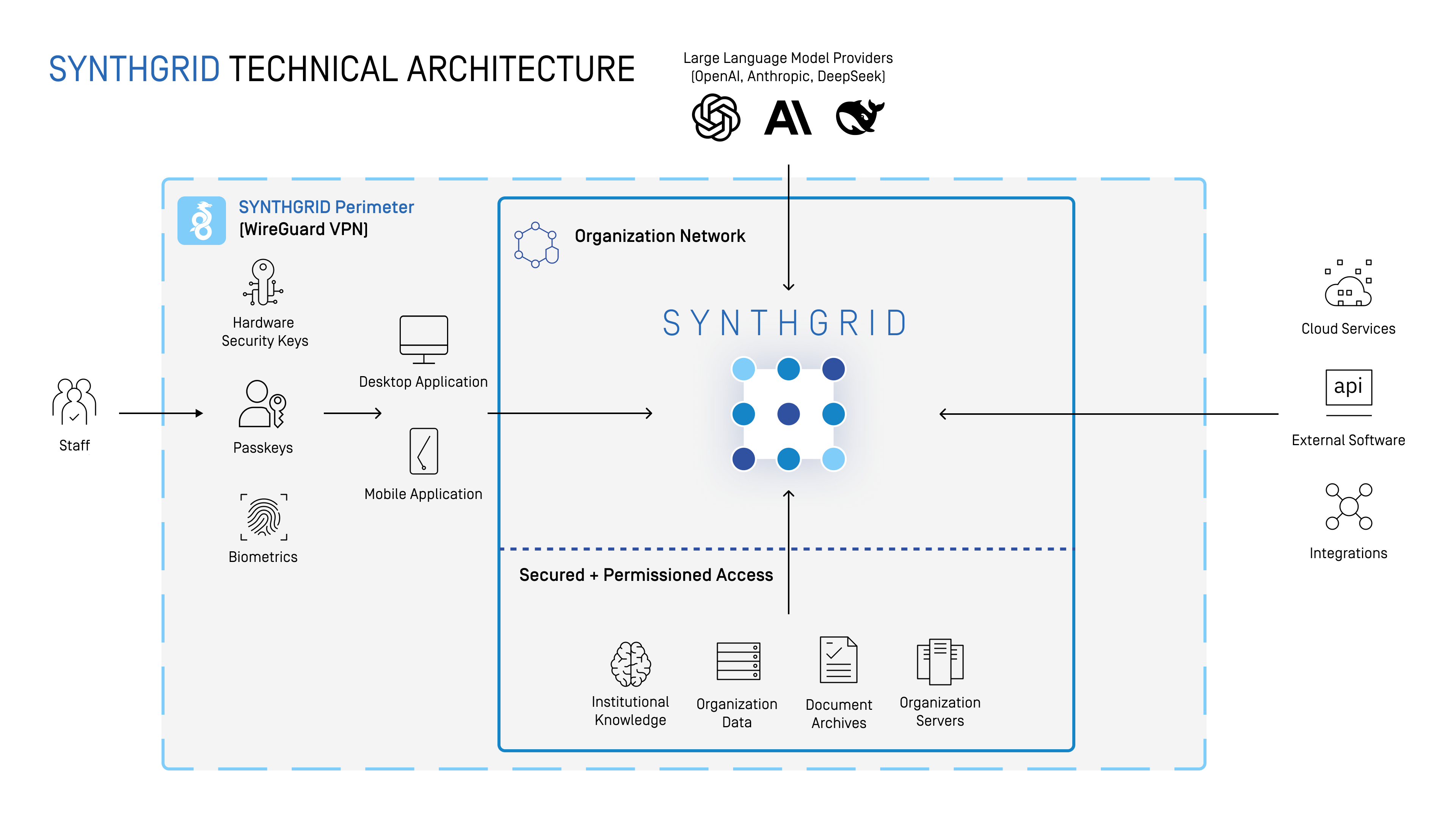
Business Presence
MindFront is always operational, running proactively in the background for your business. It will accomplish tasks either on its own or on a user’s behalf.
You can connect to MindFront at any time from Mobile or Desktop platforms (Mac/Windows/Linux supported) to view the latest status of the system, give instructions, or update tasks.
Isolated Deployments
MindFront is built to provide continuous, online, dedicated deployment for businesses.
Each organization gets a dedicated machine of its own, either on-premises or fully managed in the cloud. This ensures total isolation between deployments, allowing for secure data handling and respect for geographic boundaries.
Your business corpus — documents, conversations, knowledge bases, credentials — lives on the appliance. MindFront does not read it, sync it, or train on it, and embeddings are computed on-device, so the corpus never leaves the box. The network channels that do exist are exactly the ones named above: the LLM provider you select, web search, the integrations your organization enables, and an operational channel to MindFront carrying crash reports, error diagnostics, and service logs — never your documents, messages, or data stores.1 Air-gapped deployments have none of these channels.
Custom AI System
MindFront is built from first principles. Storage, HTTP, UI, on-device embeddings, and every integration module are written in-house — no LangChain, no AutoGPT, no off-the-shelf agent framework. We’ve made these decisions deliberately: framework-based stacks make poor tradeoffs for long-running, security-sensitive, on-premises deployments.
What we do depend on is the upstream LLM. MindFront supports a broad range of providers — your choice, switchable per deployment, and it can change at any time.
All integrations (MindFront Modules) are likewise written in-house to a high standard of reliability and ease-of-use.
Model Independence
MindFront operates with a range of LLMs across providers. We currently support and endorse the Claude series from Anthropic, the GPT series from OpenAI, and Google’s Gemini series.
For fully air-gapped deployments, MindFront runs against self-hosted open-weight models — model choice tuned to the available local hardware. For sovereign-data deployments that still want frontier models, confidential-compute / TEE-attested inference is also supported.
This is highly advantageous as a property for your business as it allows you to rapidly pivot to the optimal mix of speed, reasoning and cost based on its requirements.
Fully Streamed with Low Latency
We have designed MindFront to greatly minimize the Time To First Token (TTFT) through a combination of bespoke database design, proprietary matching algorithms for RAG, and highly optimized caching.
Every action in MindFront operates in realtime throughout the whole application - with all output, actions and tasks streamed to all of the users token-by-token as it develops.
Connected deployments send operational crash and error telemetry to MindFront — exception details, stack traces, and service diagnostics — under the telemetry agreement made at purchase and recorded on the appliance at provisioning, so MindFront can detect, triage, and fix faults in the field. This channel carries diagnostics, not your documents, conversations, or data stores. Deployments without the agreement — and all air-gapped deployments — send nothing. ↩︎